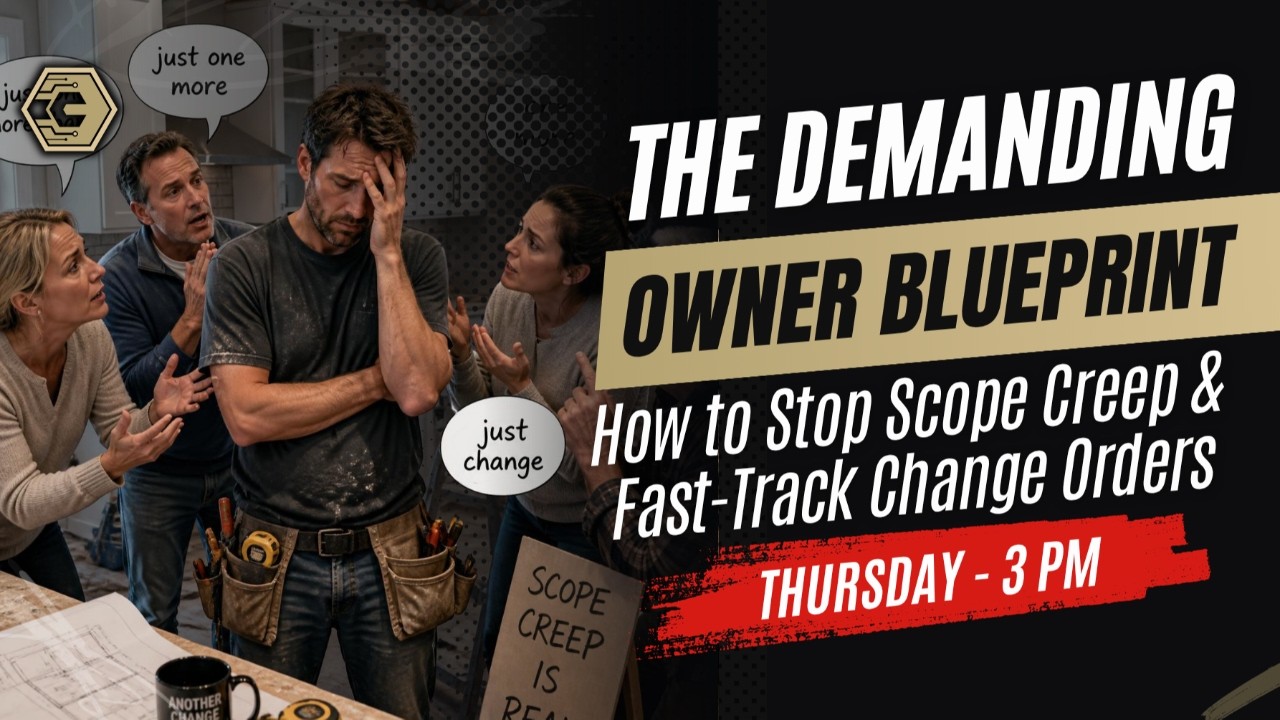
Scope Creep Isn't a Client Problem. It's a Systems Problem.
$25,000 to $75,000. That's what the average contractor gives away every year in change orders they never billed.
Not lost bids. Not bad customers. Work they already did, for free.
$75K is a kid's tuition. Stack it over a 25-year career and it's your retirement walking out the door. And it doesn't leave in one big chunk. It leaves five hundred bucks at a time, every time you say "sure, no problem" instead of reaching for a pen.
Being Busy Isn't Being Profitable
Most contractors are losing money on their best-looking jobs and don't even know it. The schedule's full, the crew's moving, the phone's ringing, and the profit's leaking out through a hundred little "while you're here, can you just..." requests that never made it onto paper.
That's not a client problem. Clients will always ask. That's what clients do.
It's a systems problem. And systems problems have system fixes. Here's the five-step one we just walked through in this week's training.
Step 1: Lock the Scope Before You Lift a Hammer
Scope creep doesn't start in the field. It starts in a vague contract.
- Exclusions first. Don't just write what you will do. Write what you won't. Disputes come from assumptions. Exclusions kill assumptions.
- Initials on the scope. Not just a signature on the last page. Initials on the scope itself. People read different when they have to initial it.
- Scope walk meeting. Walk the job with the client before work starts and say the scope out loud. Takes an hour. Saves you weeks of "I thought that was included."
Step 2: Catch the Signals Early
Scope creep never announces itself. It shows up polite: small, reasonable favors. The rule that saves you is simple. If it's not in the scope, it's a change order. Say it the moment it happens. The conversation only gets more expensive the longer you wait.
Step 3: Paper Every Change in 24 to 48 Hours
Do the work first and the paperwork later, and the "paperwork" turns into a surprise bill the client never saw coming. That's how you end up eating $10,000 in "goodwill."
The standard: every change order drafted, priced, and in the client's hands inside 24 to 48 hours, even a $40K one. Here's how we do it without estimators in the field:
- Dictate a voice note from the job site. The AI drafts the change order scope off your voice.
- It runs through pre-filled pricing calculators.
- Client gets a clean two-liner with a signature link. Signed on the spot, or the work waits.
Fill in three fields and you're done. This is the stuff that actually moves the needle, not working harder.
Step 4: Bill It the Day It's Signed
A signed change order sitting in a folder is a cash-flow problem with good manners. Bill change orders as they're signed, not at the end of the job. It protects your cash, and it trains the client that extras get paid for as you go. And if a client won't sign for a confirmed change? That's what a stop work order is for. You're not being difficult. You're running a business.
Step 5: Learn the Scripted No
The hardest part of this whole system isn't paperwork. It's the old identity. Most contractors say yes because it feels like good service, but every unpaid yes trains the client to expect free work.
So script it and practice it until it's boring: "Happy to do that for you. It's outside the original scope, so I'll have a change order to you today. As soon as it's signed, we're on it."
Same helpful tone. Completely different bank account. Clients don't respect you less for it. They trust you more, because you run a tight job.
Bonus: The Addendum to Work
One more document worth the two hours it takes to set up: the addendum to work. When a change comes up before there's a price locked, the addendum documents the change, the pricing basis, and the authorization to proceed, so the job never stalls and you never work unprotected.
The Bottom Line
You can't out-work a leaky bucket. Lock the scope. Catch the creep early. Paper every change in 48 hours. Bill it now. Say no like a professional.
Working hard doesn't buy freedom. Profit buys freedom. And profit starts with getting paid for the work you already do.
Frequently Asked Questions
What is scope creep in construction?
Scope creep is the slow addition of work that was never in the original contract. It shows up as small, reasonable requests on the job, and if none of them get documented as change orders, the contractor does the work for free.
How much do unbilled change orders cost a contractor?
Most contractors lose $25,000 to $75,000 or more per year in change orders they never billed. Over a 25-year career, that is retirement-level money.
How fast should you send a change order?
Within 24 to 48 hours of the change coming up, drafted, priced, and in the client's hands for signature before the work starts. The longer you wait, the more it feels like a surprise bill.
What is an addendum to work?
An addendum to work is a short document used when a change comes up before a price is locked. It records the change, the pricing basis, and the client's authorization to proceed, so the job keeps moving and the contractor stays protected.
Watch the full training:
Your Next Step
You just got the whole system. What you do with it is on you. Three ways to move:
1. Book a free Game Plan Call. Thirty minutes with our team. Bring your numbers, leave with a plan for your business, not a generic pitch. Book your call here.
2. Join the free Contractor AI community on Skool. The addendum-to-work template from this training, every weekly session, and a room full of contractors building the same systems. Free to join. Get in here.
3. See everything we build. Systems, AI tools, and the support team we install inside contracting businesses. Visit thecontractor.ai.
More free trainings every week inside the free Contractor AI community on Skool. New session every Thursday at 3 PM ET.


